Part 1: The Original iPhone
Every iconic piece of technology has an origin story—a moment when it wasn’t legendary yet, just a bold idea wrapped in plastic, metal, and ambition. Part 1 of our Back to the Beginning series rewinds the clock to those first releases that shaped entire eras of innovation. Before the sleek designs, the marketing hype, and the cultural status, there were prototypes, experiments, and brave leaps into the unknown. This opening chapter invites you to revisit those beginnings, celebrate the raw creativity that sparked them, and rediscover the foundations of the tech we now take for granted.
Reinventing the Phone
Before the iPhone arrived in 2007, the mobile world felt stuck. Phones were powerful on paper but awkward in practice. Web browsing was a chore, software was clunky, and every device seemed to demand its own learning curve. Most people carried at least two gadgets—an iPod for music and a phone for everything else—because no single device could do it all well.
Apple didn’t just want to make a better phone. It wanted to rethink what a phone was.
A World Ready for Change
In 2006, the smartphone landscape was dominated by BlackBerry, Nokia, Palm, and Windows Mobile. These devices were built around hardware keyboards, styluses, and tiny screens. The web was something you endured, not enjoyed. Carriers dictated what software you could install and how your phone behaved. Everything felt fragmented, slow, and constrained.
Apple saw an opportunity to break the pattern. Instead of adding more buttons or tweaking existing ideas, it chose to start from scratch.
A New Way to Interact
The original iPhone introduced something radical: a finger‑first, multitouch interface. No stylus. No keyboard. Just a screen that responded to gestures in a way that felt almost alive. Scrolling was fluid. Pinch‑to‑zoom felt magical. The entire interface adapted to whatever you were doing.
This wasn’t just a design choice—it was a philosophical one. Apple believed that hardware buttons locked devices into rigid roles. A touchscreen could become anything: a keyboard, a map, a photo album, a web browser. It was a blank canvas.
Bold Decisions and Big Limitations
For all its ambition, the first iPhone made some controversial choices. It shipped without 3G, relying instead on slower EDGE networks. There was no App Store, no GPS, no video recording, and no copy‑and‑paste. Apple kept the software locked down to maintain control and stability, which frustrated developers and power users.
But these limitations were part of a bigger strategy. Apple wanted to perfect the foundation before opening the doors. The first iPhone wasn’t meant to be feature‑complete—it was meant to be a statement.
How the World Reacted
The announcement stunned the tech industry. Some journalists were skeptical, especially about the lack of a keyboard. Competitors dismissed it as a luxury gadget that wouldn’t appeal to business users. Yet consumers were captivated. People queued outside Apple Stores just to try it. The moment they flicked through photos or zoomed in on a webpage, they understood: this was different.
Carriers, meanwhile, were forced into a new relationship with device makers. Apple insisted on controlling the software experience, updates, and branding—something unheard of at the time. AT&T agreed, and the industry would never be the same.
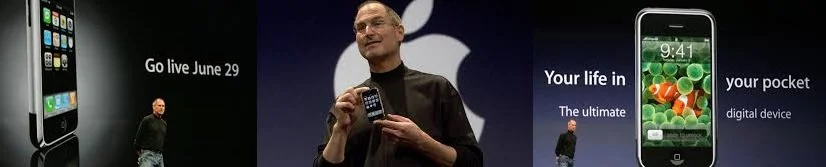
At the original iPhone’s launch in 2007, early sales signalled that Apple had a hit on its hands. When the device went on sale on 29th June 2007, Apple sold approximately 270,000 iPhones within the first 30 hours, an impressive figure for a completely new product category at the time. Momentum continued in the weeks that followed, and Apple later announced that it had sold its one millionth iPhone just 74 days after launch, underscoring the strong demand and rapid adoption that would ultimately redefine the smartphone market.

Why the Original iPhone Mattered
The first iPhone didn’t just enter the market—it reset it. It redefined what a smartphone could be and set new expectations for design, usability, and integration. It shifted power away from carriers and toward device makers. It made the idea of a “mobile computer” mainstream.
Most importantly, it laid the groundwork for the App Store, which would arrive a year later and transform the iPhone from a beautiful device into a global software platform.
The original iPhone wasn’t perfect, but it didn’t need to be. It was ambitious, confident, and forward‑looking. It solved real problems, challenged old assumptions, and opened the door to a new era of personal technology.
And this was only the beginning…